 Venus Laser
What Is a Professional Diode Laser Machine?
A professional diode laser machine is a specialized device designed for controlled light-based hair reduction and selected aesthetic applications. It commonly uses semiconductor diode technology to deliver specific wavelengths into the skin. The goal is to heat targeted hair follicles while limiting unnecessary exposure to surrounding tissue. A reliable system should offer adjustable fluence, pulse duration, spot size, and cooling control. These settings matter in every treatment.
The term “Diode Laser Professional” should describe more than a polished design or impressive power rating. It should reflect tested engineering, clear operating instructions, stable energy delivery, and support from qualified manufacturers. In practical use, an operator may check the handpiece temperature, examine the treatment area, and record the selected settings before each session. Small details often protect treatment quality. A machine without consistent calibration can create uneven results, even when its display appears accurate.
Professional practice also requires realistic consultation. Skin tone, hair thickness, medication history, and recent sun exposure can affect treatment decisions. Trained practitioners should explain expected results, possible discomfort, temporary redness, and the need for multiple sessions. No device guarantees identical outcomes for every person. That limitation deserves honest attention.
Experience helps, but it does not remove uncertainty. Even skilled operators can overlook a small change in skin condition. Regular maintenance, staff training, safety documentation, and compliance with local requirements help reduce avoidable risks. This article examines what makes a diode laser machine genuinely professional, from technical performance to responsible daily operation. The strongest choice is not always the most powerful one. It is the machine that performs predictably, supports informed decisions, and fits a carefully managed treatment environment.
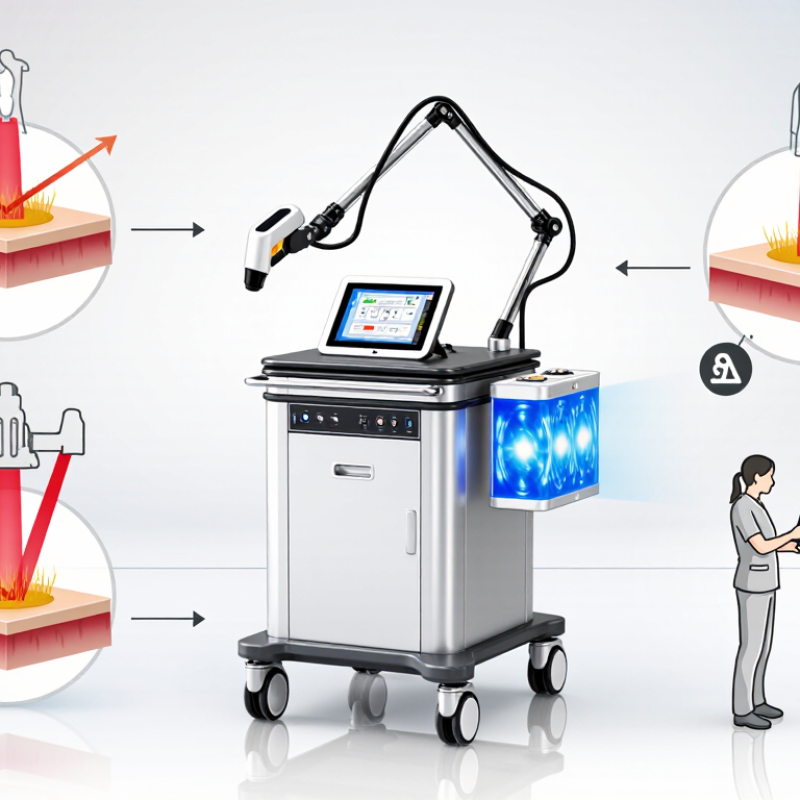
What Defines a Professional Diode Laser Machine?
What Is a Professional Diode Laser Machine?
A professional diode laser machine is defined by controlled performance, not appearance or advertising claims. Its engineering should provide stable wavelengths, adjustable fluence, suitable pulse durations, and reliable skin cooling. These controls help practitioners match treatment settings to hair thickness, skin type, and treatment area. A high price alone proves little.
Industry data shows why these standards matter. Grand View Research valued the global aesthetic lasers market at approximately USD 1.6 billion in 2023 and projects strong growth through 2030. This expansion increases equipment choices, but it also makes technical verification more important.
A professional system should include documented safety testing, clear operating instructions, emergency shutdown controls, and maintenance records. Compliance with relevant medical electrical safety and risk-management standards, such as IEC 60601 and ISO 14971, offers useful evidence of disciplined design.
Practical experience reveals smaller details. The handpiece should feel balanced after several minutes of use. The cooling contact should remain consistent across repeated pulses. Treatment parameters should be visible and difficult to change accidentally.
Operators also need structured training, because even a precise device can produce poor outcomes when settings are copied without assessment. Reports from the International Electrotechnical Commission emphasize that safety depends on both equipment design and correct use.
That point is easy to overlook. I would still question any supplier that provides impressive energy figures without independent testing, service support, or transparent clinical documentation.
FAQS
It uses controlled near-infrared light for selected cosmetic and dermatological procedures. Its main parts include a laser stack, handpiece, cooling circuit, power module, and control screen. Power alone does not define quality.
Many systems use wavelengths near 808 nanometers. Some combine 755, 808, and 1064 nanometers. Different wavelengths may suit different hair and skin responses. The operator must choose settings carefully.
Contact cooling helps protect the outer skin before, during, and after pulses. The handpiece may use a sapphire window and temperature sensor. Good cooling can improve comfort. It cannot replace careful settings.
Important settings include fluence, pulse width, repetition rate, and spot size. Thicker hair may respond differently from fine hair. Skin response also matters. More energy is not always better.
Check the cables, cooling level, emergency controls, and handpiece surface. Keep the room clean, dry, and free from reflective objects. Eye protection must match the machine’s wavelength. A dark-looking shield is not enough.
Yes, a small test area can reveal unexpected skin reactions. Wait and observe according to professional procedures. This step is easy to skip. Skipping it may create avoidable problems.
A useful display may show temperature, pulse count, energy, and error warnings. A simple screen is not automatically safer. Clear information supports better decisions. Still, screens can be misunderstood.
Clean the handpiece according to the provided instructions. Do not improvise with harsh chemicals. Review calibration records, cooling performance, and maintenance dates. A machine may still fire while performing poorly. That is the difficult part.
Review technical documents, adjustable settings, cooling reliability, and service access. Confirm training options and replacement-part availability. Ask how calibration is verified. Consider long-term servicing, not only impressive output. I would not trust power figures alone.
Conclusion
A professional diode laser machine is a precisely engineered system designed to deliver controlled, consistent, and efficient treatment energy. Unlike basic equipment, a Diode Laser Professional typically combines reliable semiconductor laser modules, an intelligent control system, an adjustable energy interface, and an effective cooling mechanism. These components work together to support stable output, user comfort, accurate parameter adjustment, and dependable operation during repeated treatments.
Diode laser technology produces treatment energy by converting electrical power into concentrated optical energy at a selected wavelength. This energy can be applied in professional settings for suitable cosmetic and aesthetic treatments, depending on the machine’s configuration and approved purpose. Common considerations include treatment area, skin type, energy level, pulse duration, and cooling requirements. Safe operation also depends on proper training, protective measures, routine cleaning, component inspection, and scheduled maintenance. When selecting a machine, users should evaluate performance stability, operating controls, safety features, service support, and suitability for their intended applications.
