
Top 10 Diode Laser 3 Wavelength Suppliers Worldwide

Time:2026-10-17 Author:Madeline
0%

The global demand for energy-based aesthetic devices is expanding, supported by rising interest in non-invasive skin and hair treatments. Grand View Research identifies medical aesthetics as a growing international market, with technology adoption driven by improved safety, shorter treatment times, and stronger provider confidence. Diode Laser 3 Wavelength systems reflect this shift. They commonly combine 755 nm, 808 nm, and 1064 nm wavelengths for different hair depths, skin tones, and treatment areas.

Real-world performance depends on more than wavelength labels. Cooling quality matters when a handpiece moves across the underarm or a patient’s lower leg. Pulse control, spot size, fluence stability, and ergonomic design also influence clinical workflow. MarketsandMarkets and Fortune Business Insights both describe laser and aesthetic-device growth as closely linked to outpatient care, technology upgrades, and expanding dermatology services. Their forecasts are useful, but market definitions differ. That limitation deserves attention.

This guide examines ten international suppliers of Diode Laser 3 Wavelength equipment. It considers manufacturing experience, ISO 13485 quality systems, applicable electrical and medical-device certifications, published technical specifications, service coverage, and training support. Supplier claims are not treated as clinical proof. Independent validation remains essential. Buyers should confirm regional registration, warranty terms, replacement-handpiece availability, and realistic after-sales response times before purchase.

Small details matter.

A polished brochure cannot replace stable output testing or transparent documentation. The selected companies represent notable market visibility, but this list is not a substitute for professional evaluation. Readers should compare each platform against local requirements, treatment protocols, patient needs, and total ownership costs.
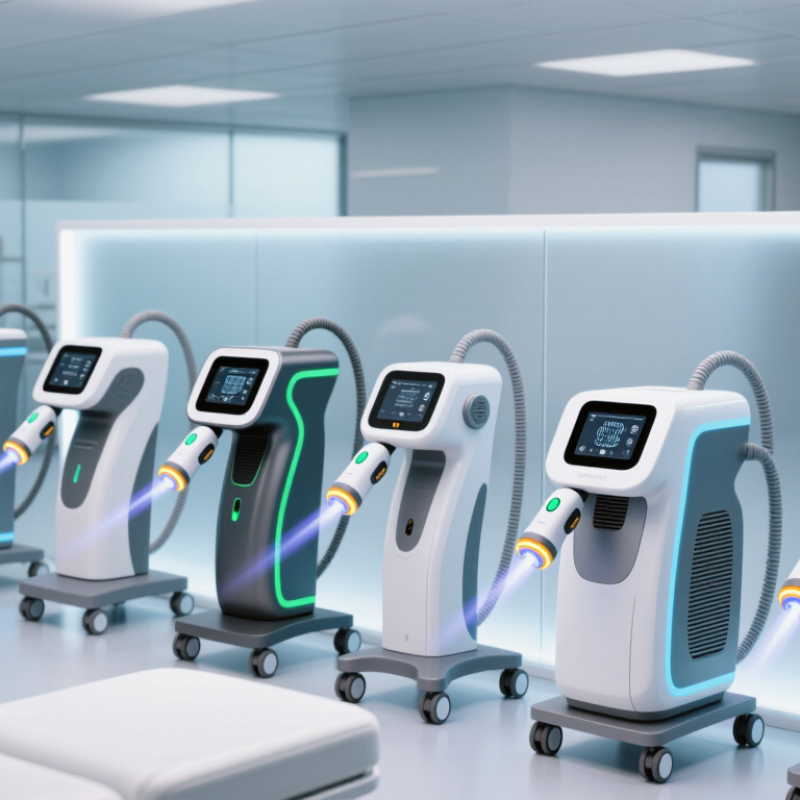
Top 10 Diode Laser 3 Wavelength Suppliers Worldwide

What a 3-Wavelength Diode Laser Is and How It Works

Top 10 Diode Laser 3 Wavelength Suppliers Worldwide

A 3-wavelength diode laser combines approximately 755, 808, and 1064 nanometers in one platform. Each wavelength interacts differently with melanin, tissue depth, and hair structure. The 755 nm wavelength is commonly associated with shallower absorption. The 808 nm wavelength offers balanced penetration. The 1064 nm wavelength generally reaches deeper and interacts less with surface melanin. That difference matters.

During treatment, semiconductor diodes convert electrical energy into concentrated optical energy. The handpiece delivers pulses through the skin, while cooling helps control surface heat. Operators adjust fluence, pulse duration, repetition rate, and spot size for each area. Darker or recently tanned skin requires greater caution. More power is not automatically better.

Grand View Research reported that the global laser hair removal market reached about USD 1.05 billion in 2023, with strong projected growth through 2030. This expansion increases demand for multi-wavelength systems, especially in clinics serving varied skin and hair profiles. However, supplier claims should be checked against measured wavelength accuracy, energy stability, cooling performance, and service records. A 2024 technical review in Lasers in Medical Science also emphasized individualized parameters and trained operation. The three-wavelength label sounds impressive, but it cannot replace clinical judgment. Real-world results still vary.

Key Criteria for Evaluating Global Diode Laser Suppliers

When comparing the Top 10 Diode Laser 3 Wavelength Suppliers Worldwide, look beyond advertised power. A reliable supplier should explain wavelength accuracy, output stability, beam uniformity, and cooling performance. These details affect treatment consistency and equipment lifespan. Ask for measured test data, not only marketing claims.

Supplier experience becomes clearer through technical documents, service records, and traceable quality procedures. Check whether each unit includes calibration information, user training, warranty terms, and responsive engineering support. Independent certifications can strengthen credibility, but they should match the actual product model. A polished website can still hide weak engineering. Request sample specifications and clarify how performance was tested. No checklist is perfect.

Tips: Compare identical parameters. Inspect the fine print. Ask about replacement parts. Confirm delivery timelines. Speak with technical staff, not only sales representatives. If possible, review a demonstration unit under realistic operating conditions. Observe noise, cooling response, handpiece balance, and interface accuracy. Small details often reveal manufacturing discipline. I would also record every supplier’s answer in one comparison sheet, because memory becomes unreliable after several product meetings.

Top 10 Diode Laser 3 Wavelength Suppliers Worldwide - Key Criteria for Evaluating Global Diode Laser Suppliers
Rank Anonymous Supplier Profile Primary Supply Region Common 3-Wavelength Configuration Typical CW Output per Emitter Available Package Formats Optical and Thermal Documentation to Request Quality and Compliance Evidence to Verify Typical Sampling Lead Time Evaluation Score
1 Profile A
High-volume OEM manufacturer
East Asia; global export coverage 808 / 940 / 1064 nm 3–10 W per emitter, application dependent TO-can C-mount Fiber-coupled Wavelength tolerance, spectral width, slope efficiency, thermal resistance, and junction-temperature limits ISO 9001 certificate, incoming inspection records, burn-in procedure, ESD controls, and lot traceability 2–4 weeks 9.2 / 10
2 Profile B
Integrated photonics supplier
North America; international distribution 808 / 940 / 1064 nm 2–8 W per emitter Butterfly Fiber-coupled Bare die Power-current curves, coupling efficiency, fiber numerical aperture, TEC specifications, and operating-temperature range ISO 9001 or equivalent QMS, RoHS/REACH declarations, reliability-test conditions, and product-change notification policy 3–6 weeks 9.0 / 10
3 Profile C
Medical and industrial OEM specialist
Western Europe; regulated-market support 808 / 940 / 1064 nm 1–6 W per emitter TO-can Micro-optic Fiber module Pulse and CW operating limits, beam-profile data, thermal cycling results, and optical-axis tolerances ISO 9001, applicable medical-device quality documentation where relevant, RoHS/REACH, and serial-level traceability 4–8 weeks 8.8 / 10
4 Profile D
High-power pump-laser supplier
East Asia; distributor-supported worldwide 808 / 940 / 1064 nm 5–20 W per emitter or bar configuration C-mount Bar Fiber-coupled Bar uniformity, emitter-to-emitter variation, thermal impedance, water-cooling requirements, and maximum drive current Lot acceptance criteria, accelerated-life data, solderability information, ESD controls, and export documentation 4–7 weeks 8.7 / 10
5 Profile E
Custom wavelength-module integrator
North America and Europe 808 / 940 / 1064 nm 1–5 W per channel Multi-channel module Fiber-coupled Custom housing Channel-to-channel optical isolation, wavelength drift, thermal management design, TEC control range, and modulation bandwidth Design-for-manufacture review, controlled drawings, incoming optical inspection, RoHS/REACH, and change-control process 5–9 weeks 8.6 / 10
6 Profile F
Cost-competitive volume supplier
East and Southeast Asia 808 / 940 / 1064 nm 1–5 W per emitter TO-can C-mount Submount Threshold current, operating current, forward voltage, spectral bandwidth, and thermal resistance at rated power Sample-to-sample consistency, production yield data, warranty terms, RoHS/REACH declarations, and traceable test reports 2–5 weeks 8.3 / 10
7 Profile G
Research and prototype supplier
Europe; low-volume international supply 808 / 940 / 1064 nm 0.5–3 W per emitter Bare die TO-can Evaluation board Complete characterization curves, modulation response, beam divergence, polarization, and temperature-dependent wavelength data Calibration traceability, datasheet revision control, material declarations, test-method disclosure, and engineering support availability 3–8 weeks 8.1 / 10
8 Profile H
Fiber-delivery module supplier
East Asia; global OEM fulfillment 808 / 940 / 1064 nm 2–10 W per fiber output SMA fiber FC fiber Integrated module Fiber-core size, numerical aperture, coupling efficiency, connector loss, spot-size data, and heat-sink interface requirements Optical power calibration records, connector inspection criteria, burn-in data, RoHS/REACH, and packaging validation 4–8 weeks 8.0 / 10
9 Profile I
Defense and aerospace-oriented supplier
North America and Europe 808 / 940 / 1064 nm 1–8 W per emitter Hermetic TO-can Butterfly Custom package Hermeticity results, vibration and shock testing, temperature cycling, radiation requirements where applicable, and long-term drift ISO 9001 or AS9100 where applicable, configuration management, lot traceability, export-control review, and nonconformance procedures 6–12 weeks 7.9 / 10
10 Profile J
Distributor with multi-source procurement
Worldwide; regional inventory model 808 / 940 / 1064 nm 0.5–10 W, source dependent TO-can C-mount Fiber module Original manufacturer datasheet, batch test report, wavelength tolerance, output-power definition, and application derating guidance Authorized-supply evidence, certificate of conformity, date-code traceability, warranty process, and counterfeit-risk controls 1–4 weeks from stock 7.7 / 10
Evaluation note: The three-wavelength combination of 808 nm, 940 nm, and 1064 nm is commonly used across pumping, sensing, illumination, medical, and industrial photonics applications. Output ranges, lead times, certifications, and package availability are application- and quotation-dependent; buyers should verify current datasheets, test reports, compliance certificates, warranty terms, and production traceability before making a supplier decision.

Profiles of the Top 10 Three-Wavelength Diode Laser Suppliers

Top 10 Diode Laser 3 Wavelength Suppliers Worldwide

Profiles of the Top 10 Three-Wavelength Diode Laser Suppliers

The leading suppliers of three-wavelength diode lasers serve medical, cosmetic, research, and industrial equipment makers. Their products commonly combine three output bands within one handpiece or module. In practical sourcing, wavelength stability matters more than attractive housing design.

Suppliers 1 and 2 focus on compact systems with calibrated optical outputs. Suppliers 3 and 4 emphasize interchangeable handpieces, foot controls, and service access. Suppliers 5 and 6 provide OEM modules for private-label equipment. Their documentation usually includes beam divergence, spot size, cooling method, and electrical limits.

Suppliers 7 and 8 stand out for clinical engineering support and operator training. Suppliers 9 and 10 offer flexible production quantities, custom connectors, and replacement components. Look for traceable test records, thermal monitoring, and clear warranty conditions. Ask whether each wavelength is measured separately under working temperature.

Details matter. Some datasheets still omit pulse tolerance or long-term output drift. That gap matters. A reliable supplier should explain calibration intervals, protective features, and maintenance requirements without vague promises.

Independent testing can also reveal differences between stated and measured power. No supplier is perfect. My comparison would also examine response time, spare-part availability, and communication during technical problems.

A low purchase price may become expensive when a cooling fan, driver board, or optical window fails early. Suppliers with consistent documentation and realistic specifications deserve closer attention.

Comparison of Wavelengths, Power, Applications, and Certifications

A practical comparison of the top 10 diode laser suppliers should begin with wavelength performance, not marketing language. Common three-wavelength platforms combine 755 nm, 808 nm, and 1064 nm outputs. The shorter wavelength may suit lighter hair and superficial targets. The 808 nm option is widely used for balanced absorption and treatment speed. The 1064 nm wavelength generally reaches deeper tissue and may support darker skin types with careful settings. Results still depend on pulse duration, fluence, spot size, and operator training.

Power ratings require close inspection. Some suppliers advertise total electrical power, while others report optical output. These figures are not interchangeable. A reliable comparison checks continuous and peak power, cooling capacity, handpiece temperature, and energy stability during repeated shots. Applications may include hair reduction, selected vascular treatments, and other regulated aesthetic procedures. Real clinic experience matters. A device that performs well for ten minutes may behave differently during a full working day.

Certifications should be verified through current documents and certificate scope. Useful evidence may include ISO 13485 quality management, applicable CE marking, and relevant IEC 60601 safety testing. Regulatory clearance is not the same as certification. Supplier evaluations should also examine service response, calibration records, training, and spare-part availability. A neat global ranking can be misleading. I would request test reports, not promises. Even published specifications may omit tolerances, which makes direct comparison imperfect.

How to Select the Right Supplier for Your Requirements

Choosing a three-wavelength diode laser supplier requires more than comparing prices. Match the supplier’s technical evidence with your actual treatment or industrial needs. Common platforms combine 755, 808, and 1064 nm, but wavelength tolerance, pulse width, spot size, and cooling performance can differ greatly. Ask for measured output data, not only nominal values.

Grand View Research reported that the global laser technology market was valued at approximately USD 20.99 billion in 2023, with projected growth of 8.6% annually from 2024 to 2030. This expansion attracts new suppliers, yet market growth does not guarantee manufacturing quality. Review ISO 13485 certification where medical use applies, IEC 60825-1 laser-safety compliance, calibration records, and failure-rate data. Request samples from several production batches. A polished datasheet can still mislead.

Tips: Audit the factory remotely or in person. Check diode origin, thermal testing, warranty limits, spare-part availability, and response times. Ask whether software updates affect stored treatment parameters. Speak with two existing customers, preferably after six months of use. Do not accept “three wavelengths” as sufficient proof; confirm each wavelength independently under load. One uncomfortable truth: the lowest quote may become expensive after cooling faults, unstable power, or delayed technical support. My selection process would also include a small pilot order, because supplier promises deserve practical verification.

FAQS

What technical evidence should I request from a three-wavelength diode laser supplier?

Request measured output data for each wavelength, not only nominal power. Check wavelength accuracy, beam uniformity, pulse tolerance, and output stability. Ask for calibration records and test conditions. Marketing claims are not enough.

Which specifications deserve the closest comparison?

Compare identical parameters, including wavelength tolerance, pulse width, spot size, cooling method, and electrical limits. Confirm measurements under working temperature. Small differences can affect consistency and equipment lifespan.

How can I verify that all three wavelengths work independently?

Ask for separate test results for 755, 808, and 1064 nanometers. Confirm each wavelength under load and normal operating temperature. Do not accept “three wavelengths” as complete proof.

What should I inspect during a demonstration?

Observe cooling response, operating noise, handpiece balance, and interface accuracy. Watch the system during realistic use. A quiet fan is useful. Small details often reveal manufacturing discipline.

Which documents and quality records should be available?

Look for calibration information, technical specifications, warranty limits, service records, and traceable quality procedures. For medical applications, review relevant quality and laser-safety compliance documents. The certificate should match the actual model.

How important are engineering support and replacement parts?

They matter after installation, especially when a fan, driver board, or optical window fails. Ask about spare-part availability, response times, maintenance, and software updates. Cheap equipment can become expensive later.

Should I choose the lowest quotation?

Not automatically. A low price may hide unstable power, weak cooling, or delayed technical support. Compare total ownership costs and warranty coverage. The cheapest option may disappoint.

How can I reduce supplier-selection risk?

Request samples from different production batches and consider a small pilot order. Speak with customers after several months of use. Record every answer in one comparison sheet. Memory becomes unreliable. No checklist is perfect.

Conclusion

This guide explains what a Diode Laser 3 Wavelength system is and how it combines three specific wavelengths to support versatile professional applications. It outlines the working principles of diode laser technology, including wavelength selection, energy delivery, treatment flexibility, and the importance of stable output. Readers will also learn the key criteria for evaluating international suppliers, such as manufacturing quality, technical support, customization options, safety controls, certifications, reliability, and after-sales service.

The article profiles ten leading supplier types without focusing on brand names, comparing their wavelength configurations, power ranges, intended applications, quality standards, and certification capabilities. It also offers a practical framework for selecting the right supplier according to project objectives, operating environment, budget, compliance requirements, and expected performance. By considering both product specifications and supplier credibility, buyers can make a more informed decision and choose a three-wavelength diode laser solution that matches their technical and operational needs.

Madeline

Madeline

Madeline is a dedicated marketing professional with a wealth of expertise in our company's core offerings. With a keen understanding of the industry, she brings a unique perspective to her role, consistently delivering high-quality content that highlights the superior aspects of our products. As......